



Forget making license plates: Select group now taught HTML, CSS, and JavaScript.

The eventual goal? That a specially selected group of 18 men be employed as Web designers and developers even before they're released and then continue beyond prison, competing with coders worldwide. The hope is that given the right skills, recidivism (returning to prison) will decrease.
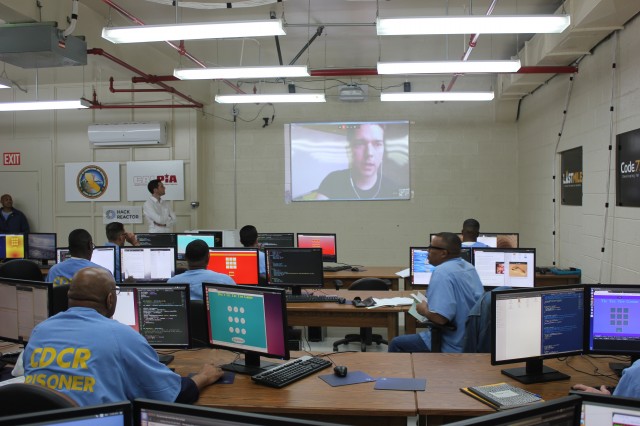
On Thursday, prisons officials and program organizers invited local media to attend a regular class session of what they've dubbed "Code 7370," a four-day-per-week, eight-hour-per-day, six-month course teaching HTML, CSS, and JavaScript. It's believed to be the first computer coding class taught inside any prison in the United States. Of course, as the class is taught inside a prison, it has an extra obstacle-inmates don't have access to the Internet at all, and their only time spent with a computer is inside the classroom. (All course materials are saved locally.)
"Specifically today we're learning how to use JavaScript to make a Tic-Tac-Toe game," said Aly Tamboura, who has been in San Quentin for eight years of a 14-year sentence for assault. "It's difficult, but I got these aha moments, and I believe that's what the course is designed to do."

When asked if he had ever used a smartphone, Tamboura said no.
"I had a flip phone-a Nextel. I don't think it was very smart," he said.
Code 7370, which began in October 2014, opened with the very basics. Lesson One was identifying the parts of a computer (mouse, keyboard, monitor) and how to turn it on. Few of the inmates had prior coding knowledge or even much computer experience.
The classes are taught virtually, via Google Hangout video conference, with an instructor from Hack Reactor, a San Francisco-based coding bootcamp. If successful, the organizers hope to duplicate this model throughout California and perhaps beyond. After a brief sample of the day's lesson, program officials took questions from reporters.
Shawn Drost, the Chief Commercial Officer at Hack Reactor, enthusiastically explained to reporters that eventually, he and his colleagues would transform the men into a "development firm for different clients." But when asked who those clients might eventually be, he was stumped.
"Good question," Drost said.
While the goal of Code 7370 is laudable, faced with competition from younger programmers, many of whom have handled computers since they were toddlers, will it make any meaningful difference for inmates? For now, it's too soon to tell.
From "The Last Mile" to the first line of code
San Quentin State Prison is one of the largest prisons in the country, and in California, it's the oldest, dating back to 1852-just two years after California became a state. The facility replaced a prison barge that was anchored not far from the prison's current site in Marin County, just north of San Francisco.
For a long time San Quentin primarily held Level 4 (maximum security) prisoners, but now it mostly holds Level 1 and Level 2 (low to minimum security) inmates, along with some death row inmates. Due to its history, the prison is also notorious for being the only California state prison that conducts executions for male inmates, although it has not carried one out since 2006.
Despite San Quentin's long and storied history, it is also one of the Golden State's most unique prisons. Unlike other facilities, San Quentin has two baseball teams, an on-site college, a degree-granting program, and even an inmate-produced newspaper, the San Quentin News.
So perhaps it's no wonder that San Quentin is now a place where over the last month, these 18 inmates have begun learning to code, line-by-line, on discarded state office computers that have been refurbished as Ubuntu desktops.
Code 7370 is a new program created by a relatively young organization that also operates within the prison called "The Last Mile," or TLM. Founded in 2010 by Chris Redlitz, a venture capitalist, and his wife, Beverly Parenti, a tech executive, TLM aims to impart Silicon Valley-style entrepreneurially minded guidance-think 60-second elevator pitches that can, and are, given at the drop of a hat-to a select group of inmates. Many of the new coders were selected from that mentoring and entrepreneurship program.
Teaching inmates productive skills is hardly new. Since 1982, California inmates have been able to learn actual job skills through the California Prison Industry Authority (CALPIA), a state-run agency that "provides productive work assignments for approximately 7,000 offenders assigned to 5,399 positions annually in California's adult correctional institutions." The products that inmates make, which range from license plates to coffee, can only be purchased by other state agencies. CALPIA has its own segregated, walled-off section inside of San Quentin-the coding classroom is adjacent to an area that used to be used to make furniture. CALPIA says that participants in its program re-offend "26 to 38 percent less often" than those from California's general prison population, which has a 61 percent recidivism rate.
Eight years later after CALPIA got its start, California voters implemented the Joint Venture Program (JVP), a way for companies to set up shop inside a prison, hire inmates, and pay them real-world competitive wages. However, most of these wages are garnished as set up under state law. Assuming a new shiny Bay Area startup wanted to hire convicts, they would have to do it through the JVP. Of course, without Internet access on the inside, getting code out to a client would be decidedly difficult.
"A way to have the computer work sent or used on the Internet would have to be done by an onsite supervisor provided by the private business that would review and inspect the work before sending on a secure private line that only the direct supervisor has access to," Rusty Bechtold, a JVP administrator, told Ars by e-mail. "I am sure there are other secure ways but that is one to prevent offenders from getting access directly to the Internet."
"I feel like a door has been opened for me to succeed."
An inmate seated in the last row, Joseph Demerson, told Ars that getting into a program like Code 7370 begins with accepting responsibility for one's own actions. Since being convicted of first-degree murder nearly three decades ago (he's due up for parole in 2016), Demerson said that over time he's learned how to deal with anger and anti-social tendencies. He described his attitude when he was younger as much more confrontational.
"One of the guys wanted extra food, and I couldn't give it to him," he said. "And so I almost got stabbed. Had I not looked I would have been stabbed. I realized, 'You could die in here.' I want to rebuild myself to be a viable member of society."
Once he made that decision, knowing that random violence could be perpetrated against him, Demerson realized that he needed to get a prison job that was "not out front" and where he would not interact with other inmates as much, "so that violent act would never happen again."
Even though he wasn't an alcoholic, he began attending Alcoholics Anonymous meetings as a way to keep his life more structured. One thing led to another, and eventually he ended up in the TLM program in 2013, and then made it into the Code 7370 course. Demerson, like some of the other TLMers, was encouraged to respond to questions on the website Quora, which are posted by TLM staff on the outside.
Demerson has responded eloquently to many questions about himself and prison life, TLM, and the Code 7370 course.
On October 13, 2014, he wrote:
I'm honored to have been chosen to a first of its kind computer coding program. The education and training gained from the 7370 coding academy will instantly change the trajectory of my life. There is nothing like being self-sufficient and educationally astute after paroling from prison. The Code 7370 program will prepare me for new opportunities in the advancing tech sector.
I feel like a door has been opened for me to succeed. I will take full advantage of this opportunity and work hard to perfect my craft. It is exciting, motivating, and just a thrill. I can't wait to get started! I'm up for the challenge and elated to be in a group full of men with lots of potential. Words cannot express my emotions right now. I feel like the hard work is finally starting to pay off. It feels good to be selected to a program that is the first of its kind inside San Quentin Prison.
In person, Emerson echoed much of this sentiment.
"I see an opportunity to change my life with this computer model," he said. "This is fun! To get out of my cell, this is Disneyland! I'm not wasting my time."