



Drug Kingpin Escaped Mexico Prison Through Hole in Cell

JULY 13, 2015
ALMOLOYA DE JUÁREZ, Mexico - Mexico’s most notorious drug lord now has one more nefarious title: serial prison escapee.
Authorities are scrambling to find Joaquin “El Chapo” Guzman after his stunning escape from a maximum-security prison west of Mexico City on Saturday night.
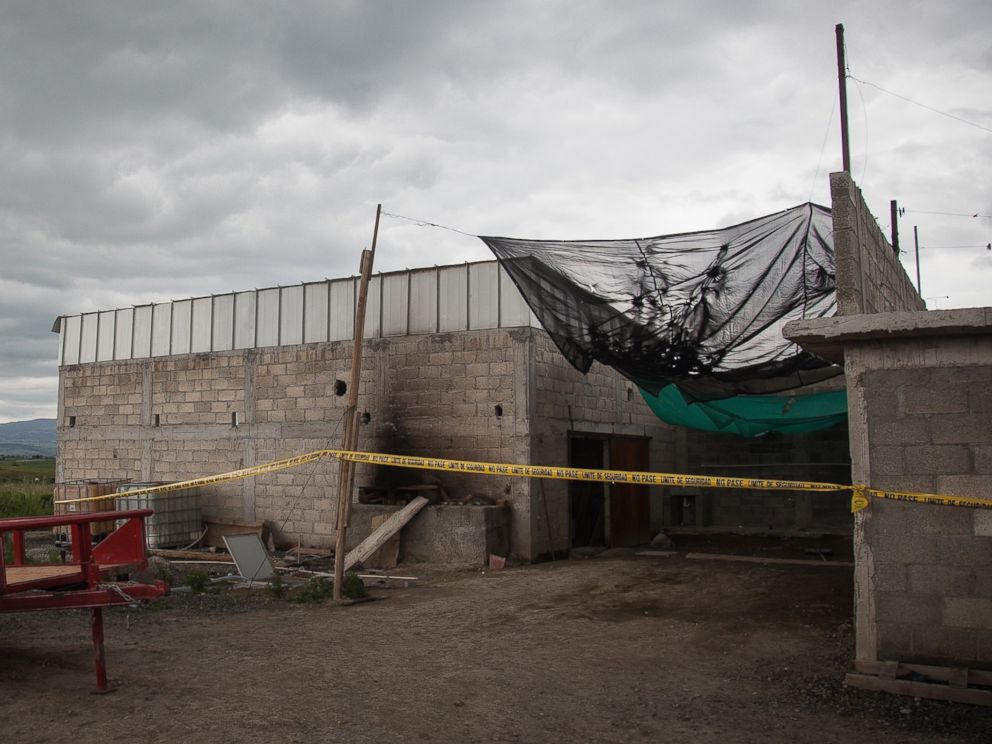
Exterior view of a half-built house used by "El Chapo" to escape from prison near the maximum security prison of Altiplano in Almoloya de Juarez, state of Mexico on July 12, 2015.
The leader of the Sinaloa Cartel stepped into a shower, crawled through a hole and vanished through a mile-long tunnel apparently built just for him.
Mexico’s President is livid. So are U.S. officials. And if Guzman gets caught, he could be sent to the United States.
Guzman, whose nickname means “Shorty,” has pulled off an elaborate escape from a maximum-security prison before. In 2001, he managed to break free while hiding in a laundry cart. It took authorities 13 years to catch him - sleeping at a Mexican beach resort.
This time, during his escape from Altiplano federal prison in Almoloya de Juárez, he took a much more sophisticated route: a tunnel complete with lighting, ventilation and even a modified motorcycle on tracks “that was likely used to remove dirt during the excavation and transport the tools for the dig,” Mexican National Security Commissioner Monte Alejandro Rubido said.
The tunnel began with a 50-by-50-centimeter (20-by-20-inch) opening inside the shower of Guzman’s cell, Rubido said.
That opening connected to a vertical passageway going more than 10 meters (33 feet) underground. The passageway, outfitted with a ladder, led to a tunnel that was about 1.7 meters (5.6 feet) tall and more than 70 centimeters (28 inches) wide.

Federal policemen inspect a pipeline under construction by the Altiplano prison in Almoloya de Juarez, Mexico on July 12, 2015. Mexican drug lord Joaquin ‘El Chapo’ Guzman has escaped from a maximum-security prison, the government said Sunday, his second jail break in 14 years. The kingpin was last seen in the shower area of the Altiplano prison in central Mexico late Saturday before disappearing. ‘The escape of Guzman was confirmed’, the National Security Commission said in a statement.
The tunnel stretched for about a mile and ended inside a half-built house. From there, Guzman’s whereabouts are anyone’s guess.
“This represents, without a doubt, an affront to the Mexican state,” Mexican President Enrique Peña Nieto said. “But also I am confident that the institutions of the Mexican state, particularly those in charge of public safety, are at the level … to recapture this criminal.”
Mexican authorities said they have brought 18 prison workers to Mexico City for questioning, but it’s unclear how many may have played a role in the escape.
Extradition limits
The United States and Mexico have worked over the years to cooperate on fighting the drug war, he said, noting that 15 traffickers were extradited to the U.S. in 2007. The arrangement was kept secret, he said.
“We worried about the level of corruption” in Mexico’s law enforcement community and elsewhere, he said.
U.S. officials might have welcomed putting Guzman in a maximum-security prison in the States, Gonzales said, “But there are limits to what the U.S. can do in respecting the sovereignty of another nation.”
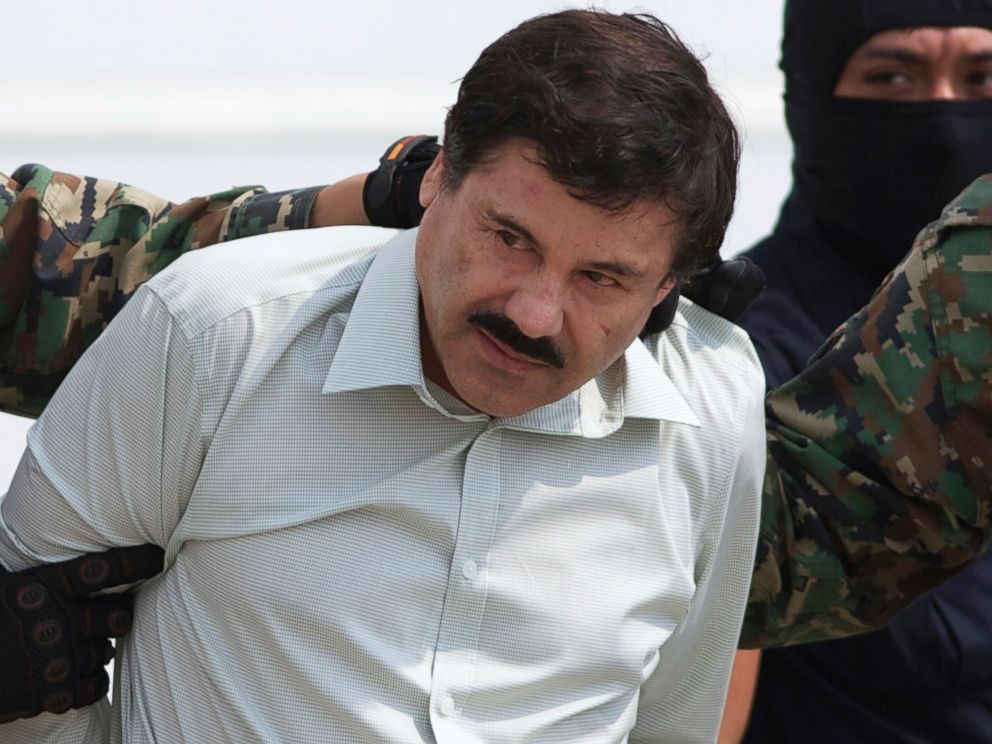
Mexican drug trafficker Joaquin “El Chapo” Guzman is escorted by marines as he is presented to the press on Saturday, Feb. 22, 2014, in Mexico City.
U.S. official: We told you so
Guzman has been a nightmare for both sides of the border. He reigns over a multibillion-dollar global drug empire that supplied much of the marijuana, cocaine and heroin sold on the streets of the U.S.
“In addition to his crimes in Mexico, he faces multiple drug trafficking and organized crime charges in the United States,” Lynch said. “The U.S. government stands ready to work with our Mexican partners to provide any assistance that may help support his swift recapture.”
U.S. officials are livid about Guzman’s escape. When he was arrested in Mexico last year, the United States asked to have him extradited, in part because of concerns of a prison escape.
“This is exactly why we argued for his extradition,” a U.S. law enforcement official said, adding that the escape shows “the strength of the cartel and his ability to pay people off.”
“If this guy can get out of prison, it shows how deep the corruption is there,” the official said.
Gonzales said that one of the challenges plaguing the Unites States’ ability to extradite is that Mexico has for years bristled at the notion that its criminals would face a death penalty or even a life sentence.
Critics have long pointed to the comparatively lighter sentences that those working in the drug trade receive in Mexico, versus sentences doled out to users.
Ioan Grillo, author of “El Narco: Inside Mexico’s Criminal Insurgency,” said there’s no doubt Guzman had help.
“You cannot build a mile-long tunnel and get into this without some level of corruption,” Grillo said.
Why corruption is so rampant
Bribing authorities is even easier when you’re a wealthy kingpin like Guzman. His carefully planned 2001 prison escape allegedly cost him $2.5 million in cooperation, according to Malcolm Beith’s book “Last Narco.”
Yet sometimes, authorities succumb to bribes not out of greed, but out of fear - especially when they’re handling someone as powerful as Guzman.
“It’s estimated that he may have murdered or ordered the murders of more than 10,000 people,” said Tom Fuentes, a law enforcement analyst and a former assistant director of the FBI.
“So this is not somebody who is playing around with prison officials,” he said. “He pretty much controls what he wants to do, and they go along with it. They look the other way to keep their families alive.”
‘The world’s most powerful drug lord’
Guzman heads the Sinaloa Cartel, which the U.S. Justice Department describes as “one of the world’s most prolific, violent and powerful drug cartels.” It says Guzman was “considered the world’s most powerful drug lord until his arrest in Mexico in February 2014.”
“The Sinaloa Cartel moves drugs by land, air, and sea, including cargo aircraft, private aircraft, submarines and other submersible and semi-submersible vessels, container ships, supply vessels, go-fast boats, fishing vessels, buses, rail cars, tractor trailers, trucks, automobiles, and private and commercial interstate and foreign carriers,” the Justice Department said earlier this year.
The trafficking network keeps U.S. drug agents busy. In January, the Justice Department unsealed indictments naming 60 members of the cartel, including Guzman’s son, Ivan Archivaldo Guzman-Salazar, aka “El Chapito.”
The main indictment said the cartel imported cocaine, methamphetamine, marijuana, other drugs and the chemicals necessary to process methamphetamine into Mexico from various countries, the U.S. Attorney for the Southern District of California said in a news release.
The drugs were then smuggled into San Diego for distribution throughout the United States, the statement said, adding that money was then laundered through a variety of means.
In just one phase of the investigation, which the Justice Department said spanned eight countries and a dozen U.S. states, authorities seized more than 1,400 pounds of methamphetamine, almost 3,000 pounds of cocaine, 12.2 tons of marijuana and 5,500 oxycodone pills, along with $14.1 million.
Also this year, federal authorities announced: Thirty-one people were charged in February with conspiring to launder $100 million for the Sinaloa Cartel in a cash-for-gold scheme; Jose Rodrigo Arechiga-Gamboa, an alleged Sinaloa kingpin who goes by “Chino Antrax,” pleaded guilty in federal court in May to helping coordinate the shipment of tons of marijuana and cocaine into the U.S.; and last month, U.S. officials announced indictments against a Baton Rouge, Louisiana-based trafficking network with ties to Sinaloa.
Toluca International Airport closed
In Mexico, the diminutive Guzman became a larger-than-life figure as he eluded authorities while expanding a drug empire that spanned the world. His life story became the topic of best-selling books and the subject of adoring songs known as narcocorridos.
In the United States, he is wanted on multiple federal drug trafficking and organized crime charges.
His nickname, which means “Shorty,” matches his 5-foot-6-inch frame.
The statement from the National Security Commission said that, at 8:52 p.m. Saturday, surveillance cameras at the Altiplano federal prison saw Guzman approaching a shower area in which prisoners also wash their belongings.
When Guzman was not seen again for some time, officials checked his cell, found it empty, and issued an alert.
Altiplano is a maximum security prison in south central Mexico.
Officials not only launched a manhunt, they also closed Toluca International Airport, a 45-minute drive away.
‘He is a complete savage’
Guzman heads the Sinaloa Cartel, which the U.S. Justice Department says is “one of the world’s most prolific, violent and powerful drug cartels.” It says Guzman was considered the world’s most powerful drug lord until his arrest in Mexico in February 2014.
“He is a complete savage,” Fuentes said. “What they do, and how they do business, is based on complete terror. … They kill journalists, politicians, police officers, corrections officers. And then not just that person, but every member of their family.”
The Sinaloa Cartel moves drugs by land, air and sea, including cargo aircraft, private aircraft, buses, fishing vessels and even submarines, the Justice Department has said.
The cartel has become so powerful that Forbes magazine listed Guzman among the ranks of Bill Gates and Warren Buffett in its 2009 list of “self-made” billionaires. Guzman’s estimated fortune at the time was $1 billion.