Barack Obama becomes first president to visit US prison
Barack Obama says that the US criminal justice system needs to distinguish between young people who make mistakes and those who are truly dangerous

Obama toured the "B" block of El Reno Federal Correctional Institution in Oklahoma, where he met six inmates convicted of drug offenses.
Nearly a quarter of the world's prison population is concentrated in American jails. However, the United States accounts for less than five percent of the world's population.
Obama wants to cut the number of people incarcerated, curb use of solitary confinement and end mandatory minimum sentences.
"We have to consider whether this is the smartest way for us to both control crime and rehabilitate individuals," he said during his visit.

After viewing a small cell that can hold up to three inmates, Obama said: "This is an outstanding institution within the system, and yet they've got enormous overcrowding issues."
The United States jails as many people as the top 35 European nations combined.
Black and Latino Americans represent 60 percent of the prison population while around 30 percent of prisoners are white.
Around 71,000 minors are also incarcerated in the United States.
"What is normal is teenagers doing stupid things," Obama said.
Recounting his discussion with inmates, he added: "When they describe their youth, these are young people who made mistakes that aren't that different from the mistakes I made, and the mistakes that a lot of you guys made."
"The difference is that they did not have the kind of support structures, the second chances, the resources that would allow them to survive those mistakes."
Obama has said he will try to pass "meaningful criminal justice reform" this year.
"This is a cause that's bringing people in both houses of Congress together. It's created some unlikely bedfellows," Obama said earlier this week.
He has tried to show Republicans angry at federal spending that prison costs are also hurting the budget.
But all that money doesn't mean prisons are in good condition.
A report by the Columbia Journalism Review on Illinois state prisons revealed vermin, flooded basements, a general lack of sanitation and crowding, with "some serving time for nothing more than driving on a revoked license."
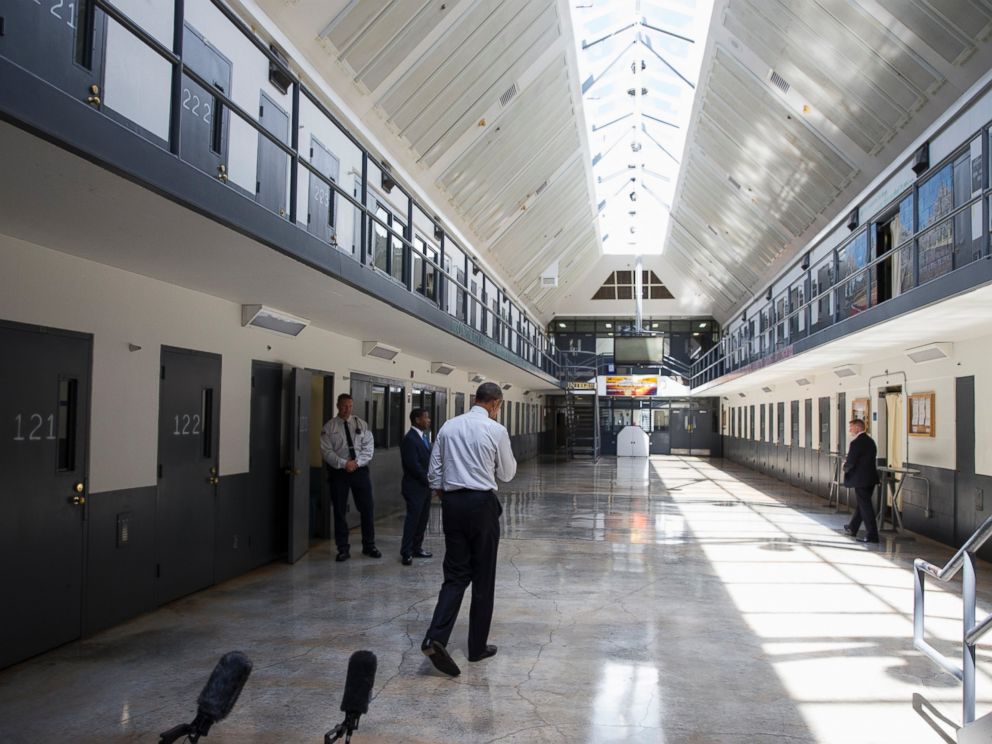
In a presidential first, Obama visited a federal penitentiary today, a medium-security prison in El Reno, Oklahoma. The trip caps a week-long effort by the White House to highlight the need for criminal justice reform.
I think we have a tendency sometimes to almost take for granted, or think it's normal, that so many young people end up in our criminal justice system," Obama said. "It's not normal. It's not what happens in other countries."
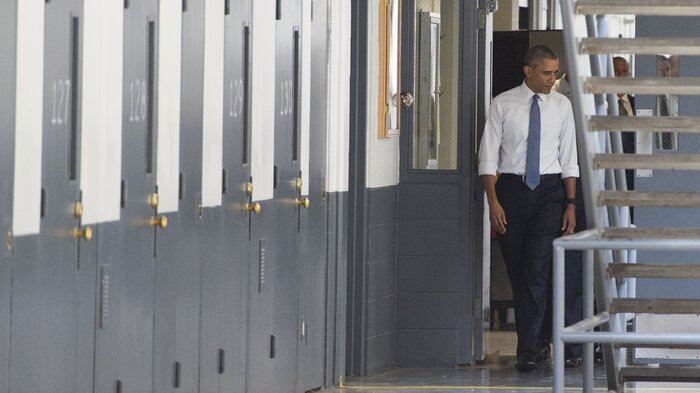
After touring Cell Block B, a two-story brick building that houses the prison’s drug abuse prevention unit, the president addressed reporters, offering praise for El Reno, but also calling attention to issues it and other prisons face as well.
“This is an outstanding institution within the system,” he said, “and yet they've got enormous overcrowding issues.”
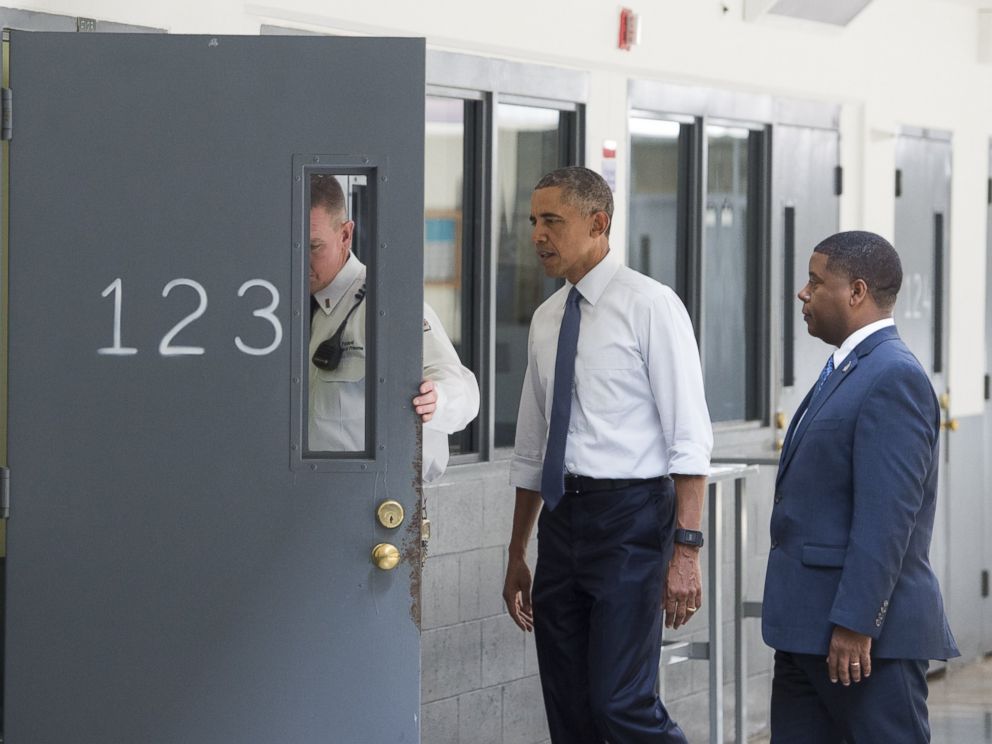
US President Barack Obama, Charles Samuels, right, Bureau of Prisons Director, and Ronald Warlick, left, a correctional officer, looks at a prison cell as he tours the El Reno Federal Correctional Institution, July 16, 2015, in El Reno, Okla.
President Obama stepped into the doorway and, in the late morning light, took in the nine-by-ten foot prison cell, the cot and the bunk bed, the flip-flops and hanging khaki uniforms, the toilet and sink tucked in the corner and small metal night stand with some magazines, books and a dictionary.
Obama stood there for a minute as corrections officer Ronald Warlick and Bureau of Prisons director Charles Samuels pointed and explained -- noting that three men lived in this crammed space.