Pope Francis visits a Philadelphia correctional facility
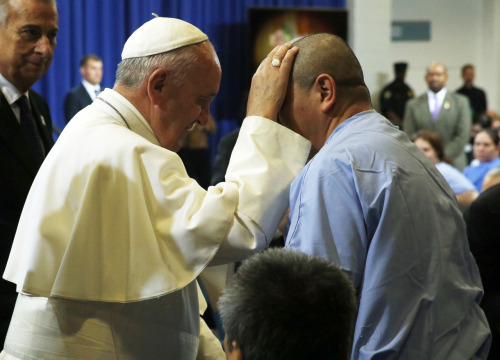
Pope Francis blesses an inmate at the Curran-Fromhold Correctional Facility in Philadelphia in September.
September 27, 2015
Philadelphia - On his last day in the United States, Pope Francis offered hope to inmates inside this city’s largest prison, telling them “that confinement is not the same thing as exclusion.”
Meeting with about 100 inmates and their families in a cinder-block gymnasium at Curran-Fromhold Correctional Facility, the pontiff implored Americans to remember prisoners, who are part of his global mission to tend to the poor, forgotten and neglected.
“I am here as a pastor but, above all, as a brother,” he said in his measured, soft baritone Spanish, “to share your situation and to make it my own.”
His Sunday began with a private meeting with victims of sexual abuse, his morning a powerful message to the faithful to embrace people pushed to society’s margins.

The 78-year-old pontiff in his pristine white robes stood before the congregation of prisoners in their drab blue uniforms and who were bearded and braided, with their necks heavily inked with tattoos, silently listening to his speech. They’d built a six-foot walnut throne for his visit.
“Any society, any family, which cannot share or take seriously the pain of its children and views that pain as something normal or to be expected,” he said, “is a society ‘condemned’ to remain a hostage to itself, prey to the very things which cause that pain.”
The inmates, members of all faiths, many of them incarcerated for violent crimes, were selected by prison staff for their good behavior once they were incarcerated, keeping with the pontiff’s message of forgiveness.
“This time in your life can only have one purpose: to give you a hand in getting back on the right road, to give you a hand to help you rejoin society,” he told them. “All of us are part of that effort, all of us are invited to encourage, help and enable your rehabilitation. ” Such work, he noted, “benefits and elevates the morale of the entire community.”

Pope Francis shakes hands with an inmate as he meets with prisoners at Curran-Fromhold Correctional Facility in Philadelphia on Sept. 27
After his address, Francis shook hands with each of the inmates sitting on plastic chairs. Three prisoners reached out to hug the pontiff.

“I did two state bids for drugs,” or about five years total, he said in advance of meeting the pontiff, sitting in a classroom at Curran-Fromhold, the largest of Philadelphia’s six prisons. In early August, he entered the system again, this time for burglary.
“I still pray and stuff,” said Dluoik, 40, briefly a college linebacker, his massive arms an inked canvas of tattoos, including a cross and the Virgin Mary. “You’ve got to find some sort of peace.” He goes to services in the prison’s modest chapel filled with plastic chairs and inspirational pennants. “I’ve got to get that clean slate. I’ve got to get that blessing.”
Edwin Lopez, 27, who has spent more than a third of his life behind bars, earning a thick and varied catalogue of charges, many related to drugs. He doesn’t know much about the first South American pope. “I hear he’s authentic,” said Lopez, also Catholic, before the pope’s visit, “a lot different from all the other popes.” During the papal visit, Lopez sat in the front row, listening attentively.
Curran-Fromhold, a tan-and-salmon mass of concrete and barbed wire, is home to 2,700 inmates, and it serves as the principal intake center for the city’s prison system.
The pope has made serving inmates and other marginalized people one of the cornerstones of his ministry. He has written letters to prisoners. On the first Holy Thursday after his election as pontiff, Francis washed the feet of inmates at a juvenile detention center in Rome, an act he repeated in April, entreating priests to spend more time in “the outskirts where there is suffering, bloodshed, blindness that longs for sight and prisoners in thrall to many evil masters.” spoke at length Sunday about the significance of Jesus’s washing of feet. “He wants to heal our wounds, to soothe our feet which hurt from travelling alone, to wash each of us clean of the dust from our journey,” Pope Francis said.
It was the third time on his historic visit to the United States that the pope reached out to the poor and disenfranchised.
Curran-Fromhold, which opened two decades ago, is referred to by virtually all visitors, long-term and fleeting, as “up on State Road,” the Northeast Philadelphia boulevard that is home to the city’s massive correctional complex that houses more than 8,000 prisoners and employs more than 2,500. A 2010 Pew study found that Philadelphia spent 7 cents of every tax dollar on incarceration, about $290 million with benefits.
Catholics represent an eighth of the city’s prison population, which is 70 percent African American and more than a third Muslim. Another third of the inmates belong to other Christian denominations.
The prison is named for warden Patrick N. Curran and deputy warden Robert F. Fromhold, who were murdered in May 1973 at the old Holmesburg Prison. The wardens’ families attended the Sunday meeting with Pope Francis.
In July, a Curran-Fromhold correctional officer was stabbed multiple times with a makeshift knife. The inmate identified is awaiting charges for shooting and injuring two Chicago Bulls fans on the elevator after a 76ers’ loss.
Deputy warden Joseph Slocum, a prison veteran of more than three decades, recalled visits by politicians and athletes to State Road, even Robert Redford and Michelle Pfeiffer when they were shooting “Up Close and Personal” (1996). Slocum earned a walk-on part. But, he said, “nothing beats this act.” Slocum retired days before the pontiff’s visit but was invited back.
The prison is home to 80 educational and vocational training programs, including a print shop, which produces material for city agencies, and furniture and upholstery workshops where inmates initially earn 45 cents an hour. In addition to crafting the nearly six-foot-tall walnut throne for Francis, inmates also planned to present him with a basket of fruit picked from the prison orchard and an engraved plaque. (Francis might need a cargo container to haul all the American-made goods presented to him during his six-day visit.)
Many inmates are “doing life on the installment plan,” said correctional officer John Tarczewski before the pontiff’s visit. There are GED classes as well as remedial courses. The population’s education ranges from minimal to college graduates, though, Tarczewski noted, “we have plenty of jailhouse lawyers.” But 60 percent of the inmates are barely literate, reading at third or fourth grade.
Before the pontiff’s arrival, Lopez said he awaited the pope’s visit and hoped for forgiveness. “A lot of us here, we need a lot of blessings. A lot of us have kids who need blessings,” he said. “It’s a shame how many times I’ve been in here.”