6 States That Now Offer Free Inmate Phone Calls | The Changing Landscape of Prison Communication
How Free Prison Phone Calls Are Reshaping Family Contact, Rehabilitation, and the Future of Corrections
Published on May 27, 2026, by InmateAid
For decades, one of the most painful realities of incarceration in America had nothing to do with prison walls or razor wire. It was the phone bill waiting on the outside.
Families with incarcerated loved ones often spent hundreds of dollars every month simply trying to stay connected. Mothers accepted collect calls while worrying about rent. Grandparents on fixed incomes declined calls because they could not afford them. Children sometimes went weeks without hearing a parent’s voice because every minute carried a price tag.
That system is finally beginning to change.
Across the United States, a growing number of prison systems are eliminating inmate phone charges altogether. What once sounded impossible, free prison calls, is now permanent policy in multiple states. Several corrections departments have concluded that family communication should not be treated as a luxury item.
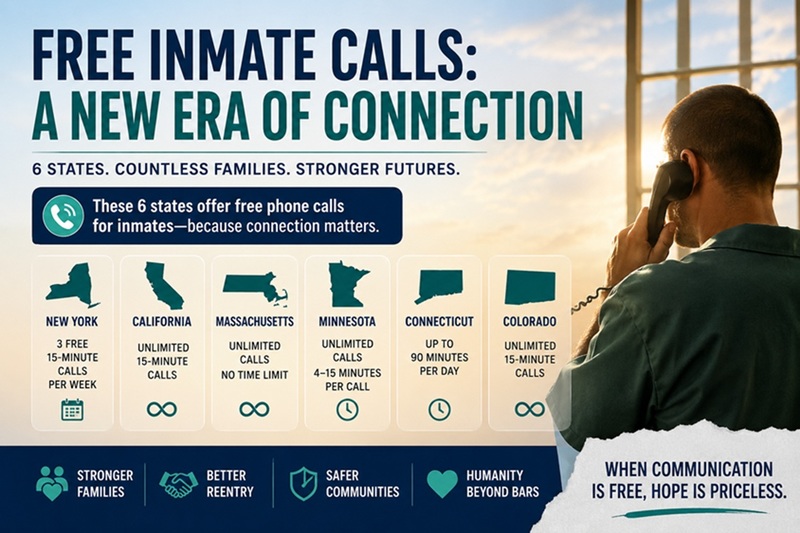
At the center of this movement are 6 state prison systems that have become national leaders in inmate calling reform:
New York | California | Massachusetts | Minnesota | Connecticut | Colorado
Each state approaches free inmate calling differently. Some provide unlimited calling. Others impose daily or weekly time limits. Some regulate call lengths by prison security level. Others allow virtually unrestricted communication during operational hours.
Together, these states are reshaping how America thinks about incarceration and family contact.
For the millions of people affected by incarceration, including the families who visit InmateAid every day, understanding these changes matters enormously.
This article breaks down exactly which states provide free inmate calls, how long inmates are allowed to talk, how the systems work operationally, why these reforms happened, what they mean for families, and why the rest of the country may eventually follow the same path.
The Old Model, How Inmate Calling Became a Massive Industry
To understand why current reforms are so significant, it helps to understand how the inmate calling industry developed in the first place.
Historically, prisons and jails treated telephone access as a controlled privilege rather than a basic communication tool. Security concerns, monitoring requirements, call recording technology, and operational costs were cited as reasons for limiting phone access.
Private telecommunications companies stepped into this environment decades ago by offering turnkey inmate calling systems. These companies installed monitored phone systems, call recording infrastructure, fraud prevention technology, and account management services.
Over time, a handful of major companies emerged as dominant players in the corrections communication space. Companies such as Securus Technologies, GTL, which later became ViaPath Technologies, IC Solutions, NCIC, Pay Tel, and others secured exclusive contracts with prison systems and county jails throughout the country.
The economics of those contracts became highly controversial.
Rather than simply charging correctional facilities directly for communication infrastructure, many telecom companies agreed to share revenue with the prison or jail itself. These “site commissions” often returned a percentage of calling revenue back to the facility or government agency.
Critics argued this created a dangerous financial incentive structure.
Under that model, incarcerated individuals and their families essentially became the revenue source funding portions of jail and prison operations. In some jurisdictions, call rates became extraordinarily expensive. International calls, interstate calls, prepaid account fees, deposit charges, and connection fees compounded the burden.
Families routinely reported paying hundreds of dollars per month simply to maintain communication.
The emotional toll was immense.
A father trying to stay connected with his children after incarceration might ration calls to once or twice per week. Mothers incarcerated far from home often struggled to maintain meaningful contact with young children. Spouses carried the dual burden of supporting a household financially while also paying inflated communication costs.
The people most affected were often the poorest.
Research consistently showed that inmate communication costs disproportionately impacted low-income families, many of whom were already dealing with the economic fallout of incarceration. When a wage earner enters jail or prison, families frequently lose income immediately. Adding costly communication expenses on top of housing, legal fees, transportation costs, and commissary support pushed many households into crisis.
Why Communication Matters So Much During Incarceration
For many years, inmate calling reform was framed primarily as a consumer pricing issue.
Today, the conversation is much broader.
Correctional administrators, researchers, mental health professionals, and criminal justice reform advocates increasingly recognize that communication is directly connected to institutional stability and successful rehabilitation.
People in custody who maintain strong family relationships generally experience better emotional outcomes during incarceration. They often exhibit fewer disciplinary problems, less violence, reduced isolation, and lower rates of depression.
More importantly, communication plays a critical role in reentry.
When incarcerated individuals maintain healthy relationships with spouses, parents, siblings, children, mentors, and community networks, they are more likely to have support upon release. That support can include housing, transportation, employment opportunities, emotional stability, and accountability.
The connection between communication and recidivism reduction has become increasingly difficult to ignore.
Many reform advocates now argue that cutting people off from family contact actually undermines public safety. If incarceration is supposed to rehabilitate and prepare individuals for reintegration, isolating them from support systems may create the opposite effect.
Children are another major factor in the reform movement.
Millions of American children have experienced parental incarceration. For many, phone calls become the primary connection with an incarcerated parent. A child hearing a parent’s voice regularly can help preserve emotional bonds that otherwise deteriorate during long sentences.
When calls become unaffordable, children often suffer the consequences.
This reality helped fuel growing bipartisan support for inmate calling reform.
The COVID Era Changed Everything
The turning point for inmate communication reform accelerated dramatically during the COVID-19 pandemic.
As correctional facilities shut down in-person visitation to prevent outbreaks, phone calls suddenly became one of the only lifelines connecting incarcerated individuals to the outside world.
Without visits, communication became more essential than ever.
Families who once relied on weekend visitation suddenly depended entirely on phones, electronic messaging, or video systems. Correctional systems faced mounting pressure to expand access.
Many facilities responded by temporarily providing free or expanded communication allowances.
The Federal Bureau of Prisons implemented universal free calling under emergency CARES Act authority. Numerous state prison systems expanded call access. Some county jails temporarily eliminated fees.
What began as an emergency response unexpectedly created a real-world experiment.
Correctional systems discovered that offering free communication did not create widespread chaos. In many cases, administrators observed improved morale among incarcerated populations during an extremely stressful period.
Families experienced immediate relief.
For the first time, many incarcerated individuals could speak freely with loved ones without every minute carrying financial pressure.
That experience changed public expectations.
Once families and incarcerated individuals experienced free calling, many began asking why it had not existed all along.
The pandemic accelerated momentum that had already been building through advocacy campaigns, lawsuits, FCC intervention efforts, and state legislation.
After COVID restrictions eased, some systems returned to paid calling structures. Others permanently embraced free communication models.
The result is the fragmented but rapidly evolving inmate communication landscape that exists today.
The 6 States Offering Free Prison Calls and How Their Systems Actually Work
Several state prison systems have fundamentally transformed how inmate communication operates.
These states are no longer experimenting with temporary relief. They have established permanent policies or legislative mandates that provide incarcerated individuals with free voice communication.
The implications are enormous.
New York, A National Symbol of Reform
New York became one of the most visible examples of statewide inmate calling reform.
Under policies administered through the New York State Department of Corrections and Community Supervision, incarcerated individuals receive three free 15-minute calls per week.
Those calls can be placed to locations throughout the United States, Canada, and qualifying U.S. territories.
The significance extends beyond the number of minutes.
For decades, New York families spent millions annually on inmate communication. By shifting the financial burden away from families, the state effectively acknowledged that maintaining communication should not depend on economic status.
Importantly, New York’s system also reduced dependence on prepaid telecom account funding. Families no longer need to continuously load money onto calling accounts simply to maintain basic communication.
That change removed a constant source of stress for many households.
California and Unlimited Free Communication
California implemented one of the most expansive inmate communication systems in the nation.
The California Department of Corrections and Rehabilitation moved toward unlimited free calling for incarcerated individuals within state prisons.
Under the current structure, inmates can make unlimited domestic and international calls without per-minute charges.
Operational restrictions still exist. Individual sessions are generally capped at 15 minutes to ensure access for other incarcerated individuals using shared equipment. However, inmates may often place another call afterward if phones remain available.
This effectively transformed communication from a rationed commodity into a normalized part of institutional life.
California’s approach reflects a growing philosophy that communication supports rehabilitation rather than undermining security.
Massachusetts Eliminated Communication Fees Entirely
Massachusetts took reform even further.
Through comprehensive no-cost communication laws, Massachusetts eliminated charges for both voice calls and video communication across state prisons and county jails.
The system allows unlimited communication volume during standard operational hours.
Facilities still maintain security protocols, including approved contact lists and monitoring procedures, but the financial barrier has been removed.
Massachusetts became one of the clearest examples of communication reform being treated as a statewide public policy issue rather than simply an operational correctional matter.
Minnesota’s Security-Tier Model
Minnesota also implemented free inmate communication across its Department of Corrections facilities.
Rather than limiting access through financial controls, Minnesota primarily manages usage through operational time windows tied to housing security classifications.
Depending on the institution and housing unit, call sessions may range from approximately 4 to 15 minutes.
Once a session ends, inmates may rejoin the queue to make additional calls.
This structure illustrates an important theme emerging nationwide.
Many prison systems are discovering that operational controls can regulate phone usage effectively without relying on high costs.
Connecticut Led the Nation
Connecticut became the first state to formally mandate free prison and jail communication.
Its legislation guarantees incarcerated individuals up to 90 minutes of free call time per day.
The law also specifically addressed concerns about facilities profiting from communication.
Connecticut’s reform became a blueprint for advocates in other states seeking legislative solutions.
Rather than simply negotiating lower rates, reformers increasingly pushed for complete elimination of communication fees.
Colorado’s Taxpayer-Funded Approach
Colorado transitioned to a taxpayer-funded communication model for state correctional facilities.
Inmates may place unlimited calls through wall phones or institutional tablets, with operational limits generally capped at 15 minutes per call session.
Colorado’s approach reflected growing recognition that communication expenses can ultimately shift costs elsewhere in society.
Supporters argue that stronger family relationships, reduced disciplinary issues, and improved reentry outcomes may offset operational expenses over time.
The Federal Prison System, A Dramatic Reversal
Federal prison communication policy has experienced one of the most dramatic changes in the inmate calling landscape.
During the pandemic, all Federal Bureau of Prisons facilities temporarily offered free inmate calling under CARES Act emergency authority.
For federal inmates and their families, the change was historic.
Universal free calling allowed incarcerated individuals to maintain frequent contact during an unprecedented period of lockdowns, visitation suspensions, and institutional instability.
Many families assumed the policy might become permanent.
Instead, the system eventually reversed course.
After the CARES Act emergency authority expired, the Bureau of Prisons initially continued free calling by absorbing costs internally. However, officials later cited budget constraints and operational concerns.
The BOP ultimately returned to paid calling structures.
Today, federal prison inmates generally pay for calls again, though rates are significantly lower than they once were.
Current federal prison call rates are capped at approximately six cents per minute.
The federal system also created a targeted incentive structure tied to the First Step Act.
Under that framework, inmates participating in qualifying Evidence-Based Recidivism Reduction programs may receive free monthly communication benefits.
This policy reflects another growing theme in corrections.
Communication is increasingly being linked to rehabilitation incentives and reentry programming.
Still, many advocates viewed the end of universal federal free calling as a major disappointment.
The pandemic proved that nationwide free communication was operationally possible within the federal system. Critics argue the rollback represented a financial choice rather than a practical necessity.
County Jails Are Becoming a Major Battleground
While state prison reforms receive significant attention, county jails may actually represent the most important frontier in inmate communication reform.
County jails differ dramatically from state prisons.
Most jail populations consist primarily of pretrial detainees who have not yet been convicted of a crime. Many remain incarcerated simply because they cannot afford bail.
Jail stays are often shorter, more unstable, and more disruptive than prison sentences.
Communication during this phase can be critically important.
People in county jails are often attempting to coordinate legal representation, maintain employment, arrange childcare, pay bills, and secure release.
Several major jail systems have begun offering free calling.
New York City Jails
Facilities operated by the New York City Department of Correction, including Rikers Island, provide free inmate calling.
Calls are typically capped around 21 minutes per session to manage equipment demand, but inmates are not restricted by overall weekly call limits.
The scale of New York City’s jail system made this reform nationally significant.
Los Angeles County Jails
The Los Angeles County Sheriff’s Department also implemented free phone communication across its massive jail network.
Given the enormous size of the L.A. County jail population, the financial impact on families had historically been immense.
San Diego and San Francisco County Jails
Both San Diego County and San Francisco County provide free inmate calling.
San Francisco in particular has become one of the strongest municipal examples of fully taxpayer-funded inmate communication.
Miami-Dade County Jails
Miami-Dade County has implemented baseline free communication allowances for detainees.
The focus includes ensuring immediate access to legal counsel and family support during the early stages of detention.
The Telecom Companies Are Adapting
As free inmate calling expands, telecommunications vendors are evolving their business strategies.
For years, inmate calling represented the financial core of correctional communication systems.
Now, companies are diversifying.
Tablet ecosystems have become increasingly important.
Modern correctional tablets offer email-style messaging, educational content, music streaming, movies, games, commissary ordering, grievance filing, law library access, telehealth, and video visitation.
Many telecom companies now generate substantial revenue through digital service ecosystems rather than traditional phone rates alone.
This shift creates a complicated debate.
On one hand, families have benefited from lower call costs and expanded access.
On the other hand, critics argue some companies are replacing one monetization structure with another. Fees associated with messaging, media downloads, video visits, and digital content can still become expensive.
The correctional technology industry is now broader than simply “inmate phones.”
It increasingly resembles a controlled digital ecosystem operating within correctional institutions.
The FCC and Regulatory Pressure
Federal regulators have also played an important role in reshaping inmate communication.
For years, the Federal Communications Commission faced mounting pressure to address extremely high inmate calling rates.
Advocacy groups, civil rights organizations, and consumer protection advocates argued that prison phone pricing was exploitative.
The FCC implemented various rate caps over time, particularly for interstate calls.
More recently, the Martha Wright-Reed Just and Reasonable Communications Act expanded FCC authority over inmate communication systems.
This legislation represented one of the most significant federal reforms in years.
The law strengthened the FCC’s ability to regulate both interstate and intrastate inmate communication rates.
Historically, intrastate calls had often escaped federal oversight, allowing some facilities and telecom vendors to maintain extremely high local rates.
The expanded authority could significantly reshape future pricing structures nationwide.
Even in facilities that do not adopt fully free communication, federal regulation may continue pushing rates downward.
Why Families Should Pay Attention Right Now
For families with incarcerated loved ones, this changing landscape matters deeply.
Many people still assume inmate calls are universally expensive because that was true for so long.
But policies are changing rapidly.
Some facilities now provide unlimited free calling. Others offer weekly allowances. Some county jails provide free booking calls or expanded communication during emergencies.
Families who stay informed may save substantial money.
They may also discover communication opportunities they did not realize existed.
At InmateAid, this is especially important because many users navigate multiple systems simultaneously.
A person may have a loved one transferred between county jail, state prison, federal custody, or private detention facilities. Communication rules can change dramatically between institutions.
Understanding the modern inmate communication environment helps families make informed decisions about:
• Prepaid calling accounts
• Tablet messaging services
• Video visitation options
• Facility communication rules
• Free call eligibility
• Vendor-specific services
• Federal versus state system differences
• Call scheduling expectations
• Communication budgeting
The more informed families become, the better positioned they are to avoid unnecessary expenses.
The Human Side of Free Communication
Statistics and policies only tell part of the story.
The emotional impact of free communication is enormous.
For incarcerated individuals, hearing the voices of loved ones consistently can reduce hopelessness, anxiety, and isolation.
For families, especially children, regular communication preserves relationships that incarceration often threatens to destroy.
A child being able to speak to a parent nightly rather than monthly changes the emotional reality of incarceration.
A spouse no longer worrying about a phone bill every time the phone rings changes household stress.
Grandparents fixed on limited retirement income no longer having to reject calls because of cost changes family dynamics.
Many correctional officials who initially resisted free calling have acknowledged surprising operational benefits.
Facilities sometimes report reduced tension, fewer disciplinary problems, and calmer institutional environments when communication access expands.
When incarcerated individuals feel connected to the outside world, institutional behavior can improve.
That does not eliminate the challenges of incarceration.
But communication can humanize an environment that often feels designed around separation and control.
Challenges Still Remain
Despite substantial progress, major challenges remain in inmate communication.
Many facilities still maintain expensive systems.
County jail communication varies enormously by region. Some local facilities continue charging high rates or imposing substantial service fees.
Video visitation remains controversial.
Some jails reduced or eliminated in-person visitation while expanding paid video visitation services. Critics argue this effectively monetized human contact in a different form.
Tablet messaging systems can also become costly.
Even when calls are free, electronic messaging services may charge per message, per photo, or per video clip.
Access inequality still exists.
Facilities in reform-oriented states may provide expansive communication benefits, while neighboring jurisdictions maintain costly systems.
The result is a highly fragmented national landscape.
A family’s communication experience often depends entirely on geography.
What the Future May Look Like
The inmate communication world is unlikely to return fully to its old structure.
Too much has changed.
Public awareness is higher than ever.
Legislators increasingly recognize the political appeal of family-focused reform measures. Criminal justice reform organizations continue pushing for expanded communication access. Courts and regulators are applying more scrutiny to pricing models.
The most likely future may involve several simultaneous trends.
First, more states will probably adopt taxpayer-funded communication models.
Second, federal regulation may continue reducing allowable call rates nationwide.
Third, telecom companies will likely expand digital ecosystems beyond voice communication.
Fourth, communication access may become increasingly tied to rehabilitation programming, education, telehealth, and reentry services.
Artificial intelligence and monitoring technologies may also reshape the industry.
Advanced voice analytics, automated threat detection, language recognition systems, and digital behavioral monitoring tools are becoming more sophisticated.
Correctional systems may justify broader communication access partly because monitoring technology has improved dramatically.
Tablet-based communication will likely continue expanding.
Future correctional systems may rely less on traditional wall phones and more on integrated digital platforms combining communication, education, mental health support, legal access, and reentry preparation.
Why This Conversation Matters Beyond Prison Walls
The debate over inmate communication is ultimately about more than phone calls. It reflects larger questions about punishment, rehabilitation, public safety, family stability, and human dignity. For decades, incarceration often operated under the assumption that isolation itself was part of punishment.
The modern reform movement increasingly argues something different. Supporters of communication reform believe strong family ties actually improve public safety outcomes. They argue that incarcerated individuals who maintain healthy relationships are more likely to return home successfully.
Critics of free calling sometimes argue taxpayers should not subsidize inmate communication.
Supporters counter that the long-term social costs of family disconnection, broken households, child trauma, and failed reentry are far greater.
This debate will continue.
But one fact is becoming increasingly clear.
The old inmate calling model is no longer universally accepted.
What once seemed permanent is changing rapidly.
The Role InmateAid Plays in This New Era
For more than a decade, InmateAid has helped families navigate one of the most confusing systems in America.
Communication has always been central to that mission.
Families often arrive overwhelmed by facility rules, telecom vendors, prepaid systems, visitation restrictions, and constantly changing policies.
As inmate communication evolves, reliable information becomes even more important.
Some facilities now provide free calls. Others still rely heavily on prepaid systems. Federal facilities operate differently from state prisons. County jail policies can vary from one county to the next.
The average family often has no idea where to begin.
That confusion creates stress at the exact moment people are already dealing with incarceration trauma.
The modern inmate communication landscape is changing faster than many people realize.
The states offering free communication today may only be the beginning.
What seemed radical just a few years ago is steadily becoming mainstream.
For families of incarcerated individuals, that shift represents something larger than reduced phone bills.
It represents recognition.
Recognition that communication matters.
Recognition that family connection matters.
Recognition that rehabilitation does not happen in isolation.
Recognition that children should not lose access to parents because of telecom pricing structures.
Recognition that supporting successful reentry begins long before release day.
The future of inmate communication is still being written.
But one thing is undeniable.
America’s correctional systems are beginning to rethink whether human connection behind bars should ever have carried such a heavy price tag in the first place.
And for millions of families affected by incarceration, that conversation could change everything.g.